



Nikkei Asia: China’s ethnic law with global reach draws backlash, from Japan to Europe
TOKYO — A new law for “ethnic unity” took effect in China on Wednesday, raising concerns among Beijing’s critics about renewed pressure on the country’s minority communities as well as how the legislation’s claims of extraterritorial jurisdiction might be applied.
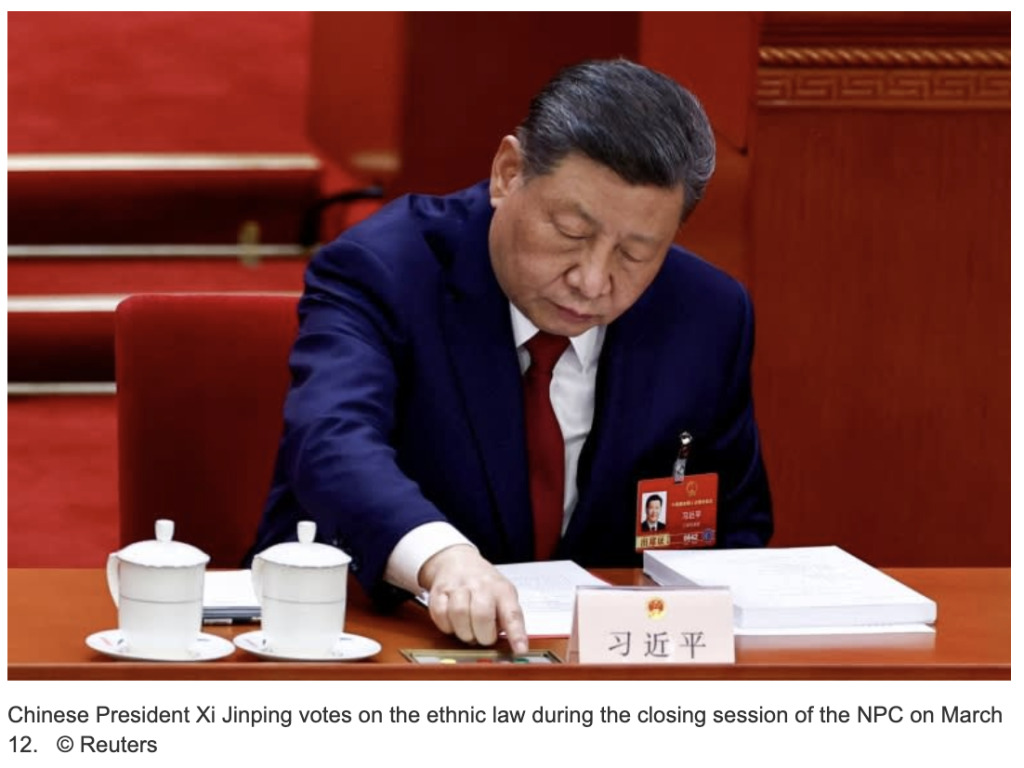
The “Law on Promoting Ethnic Unity and Progress,” which is based on President Xi Jinping’s “important thoughts” regarding minorities, passed by a wide margin at the annual National People’s Congress in March. With a preamble and 65 articles, the goal of the law is “to forge a common consciousness of community for the Chinese nation,” Chen Ruifeng, vice minister of the United Front Work Department of the Communist Party’s Central Committee and director of the National Ethnic Affairs Commission, said a week before the implementation.
The new legislation draws on “successful experiences” of the government’s policies on minorities to “declare and clearly define a political stance, specific missions and a direction” for ethnic affairs under the “new era,” Chen added, using party jargon for Xi’s reign.
Among democracies and rights activists, however, there is deep alarm. Critics say the law not only gives an impression of legal legitimacy to existing policies that squeeze minorities’ rights to their languages, cultures and traditions, but also positions Chinese authorities to exercise the law beyond their borders.
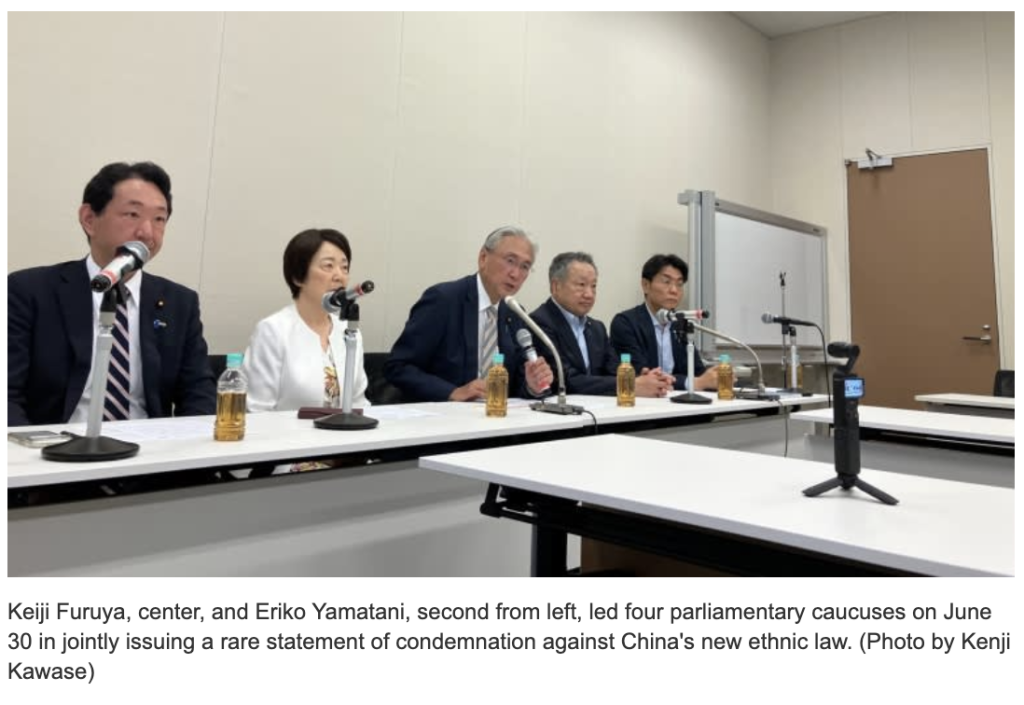
“This is something no democratic nation could tolerate,” Keiji Furuya, a member of Japan’s lower house and a close aide to Prime Minister Sanae Takaichi, told reporters on Tuesday at a briefing in a Diet building, pointing to the extraterritorial nature of the Chinese law.
Article 63 of the new law stipulates that any “external organizations and individuals” face legal responsibility for actions “aiming to undermine ethnic unity and progress or create ethnic division” in China.
Another article states that all Chinese nationals have an “obligation to preserve national unification and unity among all ethnic minorities,” rejecting any form of “interference from external forces” on ethnic matters under the “pretext of ethnicity, religion and human rights.”
Eriko Yamatani, a Japanese upper house member and chairwoman of parliamentary support groups for Tibetans and ethnic Mongolians in the Inner Mongolia region of China, expressed worry over the “ambiguous wording” and the law’s potential impact on free speech in Japan.
Four Japanese parliamentary caucuses — supporting the causes of Uyghurs, Tibetans and Southern (Inner) Mongolians, along with a group following alleged human rights abuses in China — issued a joint statement condemning the new law and calling for its abolition on Tuesday.
Both Yamatani and Furuya, who has been involved in China rights issues for years and was sanctioned by Beijing for “colluding with Taiwan separatists,” stressed that Japanese lawmakers should strongly object to the law as it affects people outside China.
The appeal from Japanese legislators comes as Tokyo and Beijing remain mired in diplomatic tensions. Relations have sharply deteriorated since November, when Takaichi suggested that a Chinese attack on Taiwan could pose an existential threat to Japan, potentially requiring a military response.
[/cmsmasters_text][/cmsmasters_column]
The joint condemnation by the parliamentary caucuses is based on two resolutions adopted in both Diet houses in 2022, which called out serious human rights abuses in Xinjiang, Tibet, Inner Mongolia and Hong Kong. Takaichi herself used to be an active member of these caucuses and chaired the Southern Mongolian advocacy group, although Furuya clarified that since becoming prime minister she “no longer takes part in any specific activities” of these leagues, remaining strictly as an “adviser.”
Japanese lawmakers are far from alone in voicing concern over the new Chinese legislation.
Volker Turk, the United Nations High Commissioner for Human Rights, or UNHCR, called on China to repeal the law in a speech at the Human Rights Council in Geneva in mid-June.
“I am very concerned about China’s counterterrorism and assimilation policies, particularly as they affect minorities in the Xinjiang, Inner Mongolia and Tibetan regions,” the top human rights watchdog said. “The new law on ethnic unity risks deepening restrictions on freedoms of language, education, practice of religion, culture, expression and assembly, and penalizing the peaceful exercise of minority rights in general.”
Turk emphasized, “I call for the law to be repealed and for these practices to end.”
In a statement on Monday, U.S. House Select Committee on China Chairman John Moolenaar said the law is an “ugly escalation of the CCP’s cruelty and paranoia, and China plans to use it to continue its harassment and intimidation of critics who live beyond its borders,” while “legitimizing” abuse of minorities.
The European Parliament in April adopted a resolution that “strongly condemns” the ethnic law, also calling for its repeal. The parliament said the law embodies “China’s repressive assimilation policies and consequent violations of universal human rights, including in Tibet, Xinjiang and Inner Mongolia,” noting how it prioritizes the Mandarin language in education, public life and media.
The resolution urged all European Union member states to suspend extradition treaties with China “to protect persecuted individuals residing in the EU from the risks of transnational repression under this law,” and called on the European Council to “implement the EU Global Sanctions Regime against those responsible for the new law.”
Human rights advocates say Beijing’s move will only increase pressure on minorities in China.
“This law criminalizes aspects of people’s and communities’ identities the authorities deem problematic,” said Shane Yi, researcher at the Network of Chinese Human Rights Defenders, or CHRD. “This approach has nothing to do with unity, and everything to do with punishing legally protected characteristics.”
Yi said Chinese authorities are seeking to “create a veneer of legality for discrimination and repression.”
“If the government is serious about ethnic unity, it should drop this law and allow accountability for vast violations,” he said.
China, which routinely denies all accusations of human rights abuses, has been hitting back at criticism of the law. Hu Weilie, its vice minister of justice, rejected concerns over the foreign enforcement clause as a “distorted reading” and a “smear campaign.” The law, according to Hu, is “based on national conditions, in accordance with legal principles and in line with international customary practices.”
A fresh accusation of repression came on the eve of the law’s implementation.
The U.S.-based Tibet Action Institute said that the Gangjong Sherig Academy in the Tibetan prefecture of Golok, in China’s Qinghai province was forced to close on June 24. The organization said the school, founded by local spiritual leader Tulku Hungkar Dorje Rinpoche, was the only institution providing senior high school-level education in its county.
The closure means students “will now be compelled to enroll in state-run boarding schools with a highly politicized curriculum and Mandarin-only instruction,” the organization said.
Tulku Hungkar Dorje Rinpoche was known for supporting Tibetan-led education and refusing to endorse the Panchen Lama chosen by Beijing — the top spiritual leader after the Dalai Lama. The Tibet Action Institute said that “he is believed to have fled to Vietnam, where he was reportedly arrested in the presence of Chinese officials and died in custody in April 2025.”
Working groups and special rapporteurs under the UNHCR, including one focused on arbitrary detention and extrajudicial executions, have been calling for accountability on the part of the Communist regimes in China and Vietnam, to virtually no avail.
“The sudden shutdown of yet another renowned Tibetan school — in this case the only senior high school in the area — showcases China’s escalating moves to stamp out Tibetan identity, language and culture as its ethnic erasure law comes into effect on July 1,” said Lhadon Tethong, director of the Tibet Action Institute.
Leave a Reply